CAPSULITE ADESIVA
EVIDÊNCIAS ATUAIS PARA A PRÁTICA FISIOTERAPÊUTICA
DOI:
https://doi.org/10.64956/gm-unifacol.v2i1.78Palavras-chave:
Ombro congelado, Capsulite Adesiva, Reabilitação, Fisioterapia, Tratamento Fisioterapêutico.Resumo
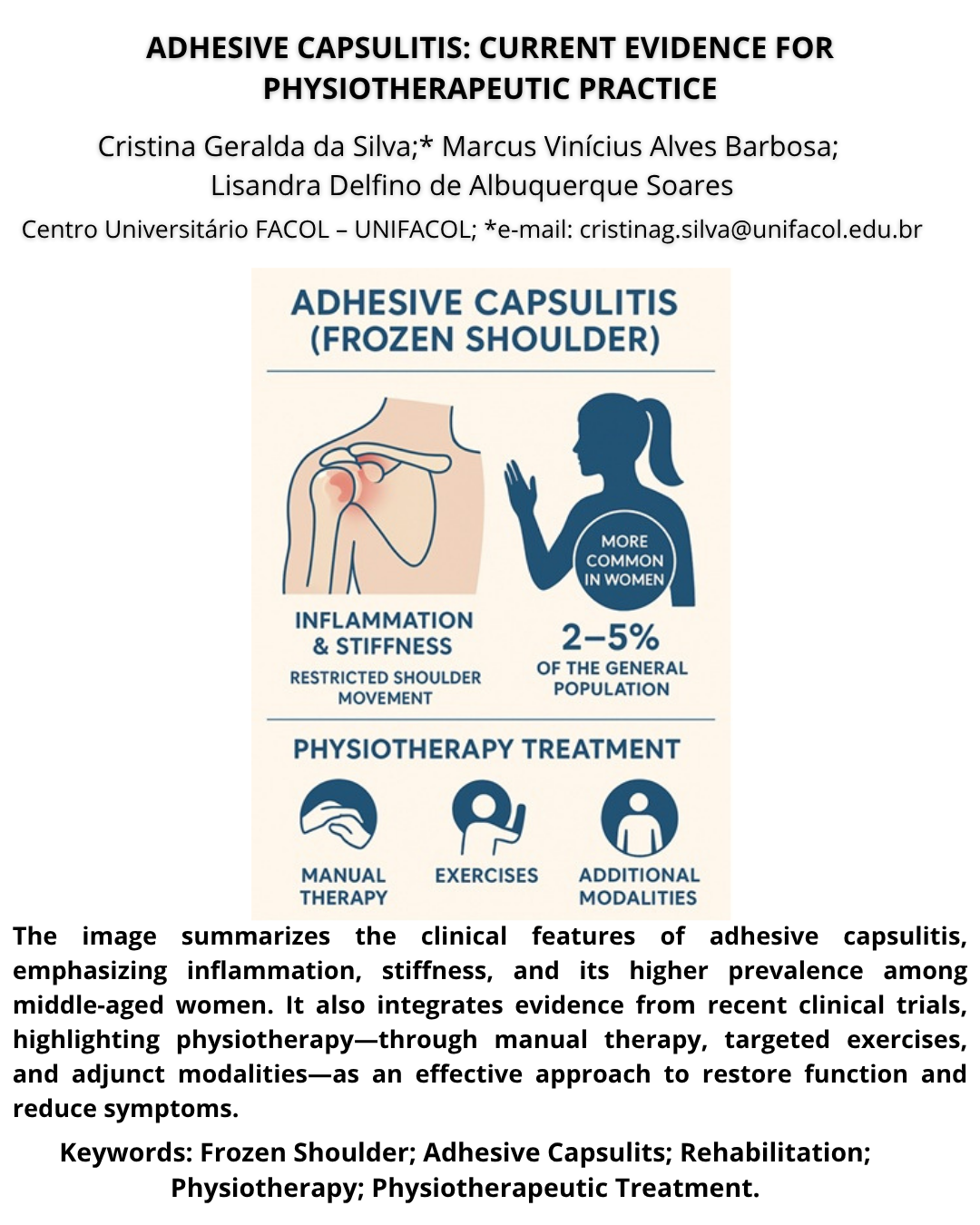
A capsulite adesiva também conhecida como ombro congelado é caracterizada pela inflamação e rigidez progressiva da articulação glenoumeral, que resulta na restrição significativa dos movimentos ativos e passivos do ombro. A condição é mais comum nas mulheres do que nos homens e atingi aproximadamente 2 % a 5 % da população geral, especialmente na faixa etária entre 40 a 60 anos. A capsulite adesiva pode ser classificada em primária e secundária e sua evolução ocorre em três estágios distintos. Entre os tratamentos disponíveis a fisioterapia vem ganhando destaque por utilizar de abordagem não invasiva, voltadas para o alívio da dor e a recuperação da amplitude de movimento. Fundamentando nesse contexto, objetivou-se com o presente estudo revisar na literatura, entre ensaios clínicos, os tratamentos fisioterapêuticos disponíveis e o manejo da capsulite adesiva do ombro. Para essa finalidade, esse estudo tratou-se de uma revisão integrativa da literatura, que utilizou as seguintes bases de dados: Literatura Latino-Americana e do Caribe em Ciência da Saúde (BVS/Lilacs), Pubmed/Medline, Physiotherapy Evidence Database (PEDro). Com base nos critérios de elegibilidade e na estratégia PICOS, foram incluídos 08 artigos, os quais possuíam o período de publicação entre 2020 e 2025. Assim, foram obtidos como desfechos nessa revisão com base em ensaios clínicos que técnicas manuais, exercícios e modalidades adicionais apresentam benefícios distintos e complementares nessa disfunção.
Referências
AMJAD, Fareeha; ASGHAR, Hasha. Comparative effects of gong’s mobilization and mobilization with movement in patients with adhesive capsulitis: a randomized clinical trial. Scientific Reports, v. 15, n. 1, p. 4272, 2025.
ATAN, Tuğba; BAHAR-ÖZDEMIR, Yeliz. Efficacy of high-intensity laser therapy in patients with adhesive capsulitis: a sham-controlled randomized controlled trial. Lasers in Medical Science, v. 36, n. 1, p. 207-217, 2021.
BABU, Sreekumar K. R. et al. Efeito da mobilização de Gong versus fisioterapia convencional entre pacientes diabéticos tipo II com capsulite adesiva. Cureus, v. 16, n. 6, 2024.
BALCI, Nurcan C. et al. Acute effect of scapular proprioceptive neuromuscular facilitation (PNF) techniques and classic exercises in adhesive capsulitis: a randomized controlled trial. Journal of Physical Therapy Science, v. 28, n. 4, p. 1219-1227, 2016.
BIRADI, Mahesh et al. Effects of anterior versus posterior end range mobilizations on shoulder rotations range of motion in adhesive capsulitis stage II. Indian Journal of Physiotherapy & Occupational Therapy, v. 14, n. 2, p. 91-96, 2020.
CHIDAMBARAM, Ramesh; MURUGANANDAM, Prakash; BHANDURE, Kanchan S. The efficacy of sleeper’s stretch and movement with mobilization on pain, range of motion and functional capacity in patients with adhesive capsulitis. Indian Journal of Physiotherapy & Occupational Therapy, v. 14, n. 4, p. 149-155, 2020.
D’ORSI, Giuseppe Maria et al. Treatment of adhesive capsulitis: a review. Muscles, Ligaments and Tendons Journal, v. 2, n. 2, p. 70, 2012.
DIAS, Roger; CUTTS, Steven; MASSOUD, Samir. Frozen shoulder. British Medical Journal, v. 331, n. 7530, p. 1453-1456, 2005.
DUZGUN, Ibrahim et al. Which method for frozen shoulder mobilization: manual posterior capsule stretching or scapular mobilization? Journal of Musculoskeletal & Neuronal Interactions, v. 19, n. 3, p. 311, 2019.
EZZATI, Kaveh et al. The effects of photobiomodulation on shoulder pain, muscle thickness, and function in subjects with adhesive capsulitis. Caspian Journal of Neurological Sciences, v. 8, n. 2, p. 90-97, 2022.
HSU, Jason E. et al. Current review of adhesive capsulitis. Journal of Shoulder and Elbow Surgery, v. 20, n. 3, p. 502-514, 2011.
JASON, J. I.; GANESH SUNDARAM, S.; VENGATA SUBRAMANI, M. Physiotherapy interventions for adhesive capsulitis of shoulder: a systematic review. International Journal of Health Sciences and Research, v. 3, n. 6, p. 1318-1325, 2015.
JAYSON, Malcolm I. V. Frozen shoulder: adhesive capsulitis. British Medical Journal (Clinical Research Edition), v. 283, n. 6298, p. 1005, 1981.
JOHNSON, Aaron J. et al. The effect of anterior versus posterior glide joint mobilization on external rotation range of motion in patients with shoulder adhesive capsulitis. Journal of Orthopaedic & Sports Physical Therapy, v. 37, n. 3, p. 88-99, 2007.
KAMERKAR, Shashikant S.; KUMAR, Naresh; TAYADE, M. C. Study of effectiveness of scapular mobilization versus proprioceptive neuromuscular facilitation technique among subjects with adhesive capsulitis at primary care level. Pravara Medical Review, v. 14, n. 1, 2022.
KHAN, Abid Hasan et al.et al. Efficacy of proprioceptive neuromuscular facilitation patterning on the upper extremity and scapula in patients with adhesive capsulitis: a randomized controlled trial. Trials, v. 26, n. 1, p. 146, 2025.
KUBUK, Berktuğ Selçuk et al. The effects of end-range interventions in the management of primary adhesive capsulitis of the shoulder: a systematic review and meta-analysis. Disability and Rehabilitation, v. 46, n. 15, p. 3206-3220, 2024.
NOUREEN, Rabia et al. Efficacy of three directional capsular stretching versus angular joint mobilization in patients with frozen shoulder: a randomized controlled trial. Indian Journal of Physiotherapy & Occupational Therapy, v. 15, n. 3, p. 212-217, 2021.
PATEL, Riki et al. A comprehensive update of adhesive capsulitis and minimally invasive treatment options. Psychopharmacology Bulletin, v. 50, n. 4 Suppl 1, p. 91, 2020.
RAGHAV, Deepak; PANDIAN, P. R. K.; DWIVEDI, Amit. Assessment of the effectiveness of kinetic chain approach for primary adhesive capsulitis of shoulder: an experimental study. Journal of Clinical & Diagnostic Research, v. 17, n. 6, 2023.
RANGAN, Andrew; HANCHARD, Nigel; MCDAID, Chris. What is the most effective treatment for frozen shoulder? British Medical Journal, v. 354, 2016.
ALSUBHEEN, Sana’a A. et al. The diabetic shoulder: a literature review. Journal of Diabetes and Clinical Research, v. 1, n. 2, p. 59-70, 2019.
SULE, Kedar et al. Comparison of conventional therapy versus sleeper stretch with conventional therapy in adhesive capsulitis. International Journal of Health Sciences and Research, v. 5, n. 11, p. 186-192, 2015.
TEYTELBAUM, Daniel E. et al. Efficacy of a high-intensity home stretching device and traditional physical therapy in non-operative management of adhesive capsulitis: a prospective randomized controlled trial. BMC Musculoskeletal Disorders, v. 25, n. 1, p. 305, 2024.
UPPAL, Hardeep S.; EVANS, Jonathan P.; SMITH, Christopher. Frozen shoulder: a systematic review of therapeutic options. World Journal of Orthopedics, v. 6, n. 2, p. 263, 2015.
ZREIK, Nabil H.; MALIK, Rayaz A.; CHARALAMBOUS, Charalambos P. Adhesive capsulitis of the shoulder and diabetes: a meta-analysis of prevalence. Muscles, Ligaments and Tendons Journal, v. 6, n. 1, p. 26, 2016.