ADHESIVE CAPSULITIS: CURRENT EVIDENCE FOR PHYSIOTHERAPEUTIC PRACTICE
EVIDÊNCIAS ATUAIS PARA A PRÁTICA FISIOTERAPÊUTICA
DOI:
https://doi.org/10.64956/gm-unifacol.v2i1.78Keywords:
frozen shoulder, adhesive capsulits, rehabilitation, physiotherapy, physiotherapeutic treatment.Abstract
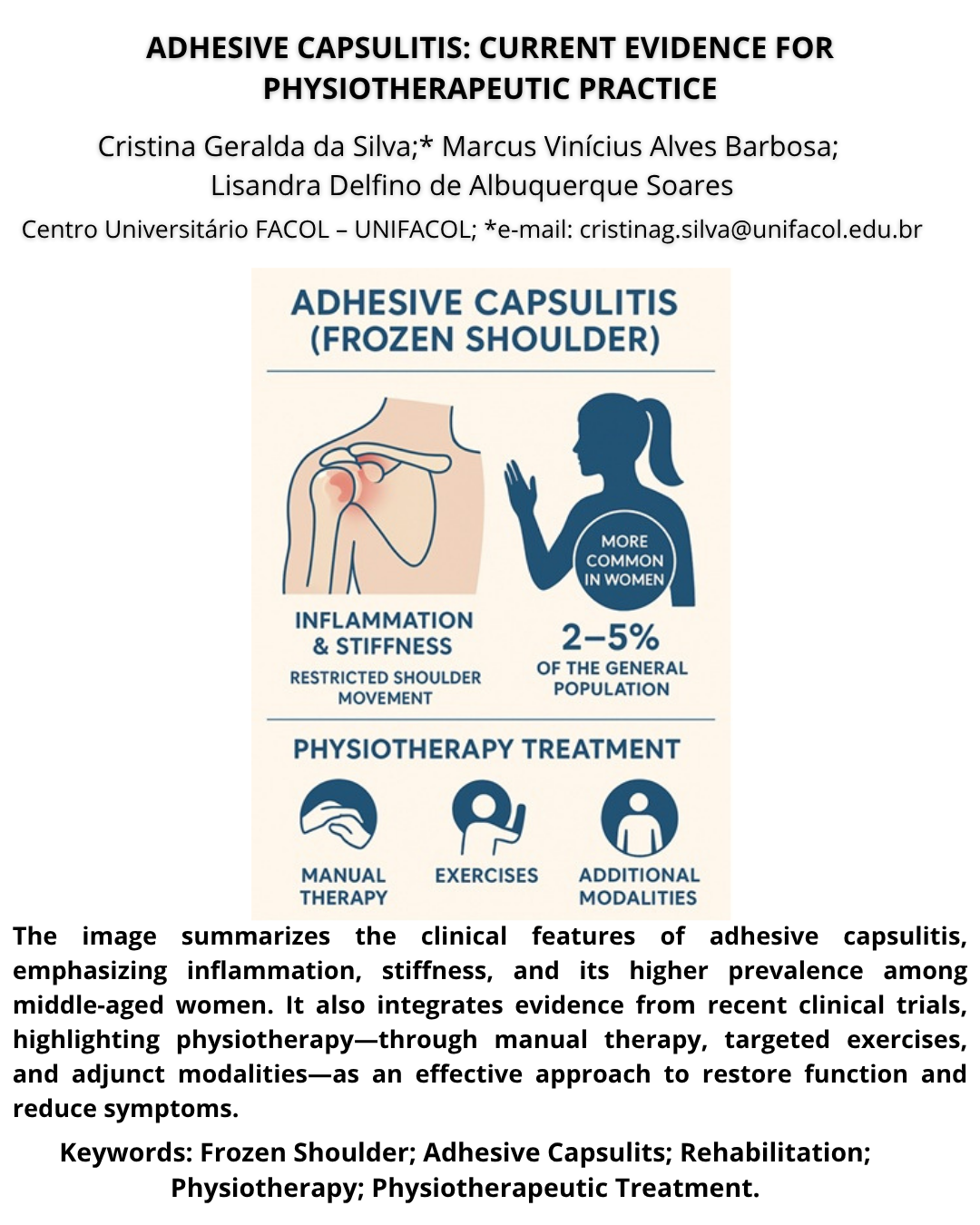
Adhesive capsulitis, also known as frozen shoulder, is characterized by inflammation and progressive stiffness of the glenohumeral joint, resulting in significant restriction of active and passive shoulder movements. The condition is more common in women than in men and affects approximately 2% to 5% of the general population, especially those between the ages of 40 and 60. Adhesive capsulitis can be classified as primary or secondary, and its progression occurs in three distinct stages. Among the available treatments, physical therapy has gained prominence for its non-invasive approach, focused on pain relief and recovery of range of motion. Based on this context, the objective of this study was to review the literature, including clinical trials, on the available physical therapy treatments and management of adhesive capsulitis of the shoulder. For this purpose, this study was an integrative review of the literature, using the following databases: Latin American and Caribbean Health Sciences Literature (BVS/Lilacs), Pubmed/Medline, and Physiotherapy Evidence Database (PEDro). Based on the eligibility criteria and the PICOS strategy, eight articles were included, which were published between 2020 and 2025. Thus, the following outcomes were obtained in this review based on clinical trials were that manual techniques, exercises and additional modalities present distinct and complementary benefits in this dysfunction.
References
AMJAD, Fareeha; ASGHAR, Hasha. Comparative effects of gong’s mobilization and mobilization with movement in patients with adhesive capsulitis: a randomized clinical trial. Scientific Reports, v. 15, n. 1, p. 4272, 2025.
ATAN, Tuğba; BAHAR-ÖZDEMIR, Yeliz. Efficacy of high-intensity laser therapy in patients with adhesive capsulitis: a sham-controlled randomized controlled trial. Lasers in Medical Science, v. 36, n. 1, p. 207-217, 2021.
BABU, Sreekumar K. R. et al. Efeito da mobilização de Gong versus fisioterapia convencional entre pacientes diabéticos tipo II com capsulite adesiva. Cureus, v. 16, n. 6, 2024.
BALCI, Nurcan C. et al. Acute effect of scapular proprioceptive neuromuscular facilitation (PNF) techniques and classic exercises in adhesive capsulitis: a randomized controlled trial. Journal of Physical Therapy Science, v. 28, n. 4, p. 1219-1227, 2016.
BIRADI, Mahesh et al. Effects of anterior versus posterior end range mobilizations on shoulder rotations range of motion in adhesive capsulitis stage II. Indian Journal of Physiotherapy & Occupational Therapy, v. 14, n. 2, p. 91-96, 2020.
CHIDAMBARAM, Ramesh; MURUGANANDAM, Prakash; BHANDURE, Kanchan S. The efficacy of sleeper’s stretch and movement with mobilization on pain, range of motion and functional capacity in patients with adhesive capsulitis. Indian Journal of Physiotherapy & Occupational Therapy, v. 14, n. 4, p. 149-155, 2020.
D’ORSI, Giuseppe Maria et al. Treatment of adhesive capsulitis: a review. Muscles, Ligaments and Tendons Journal, v. 2, n. 2, p. 70, 2012.
DIAS, Roger; CUTTS, Steven; MASSOUD, Samir. Frozen shoulder. British Medical Journal, v. 331, n. 7530, p. 1453-1456, 2005.
DUZGUN, Ibrahim et al. Which method for frozen shoulder mobilization: manual posterior capsule stretching or scapular mobilization? Journal of Musculoskeletal & Neuronal Interactions, v. 19, n. 3, p. 311, 2019.
EZZATI, Kaveh et al. The effects of photobiomodulation on shoulder pain, muscle thickness, and function in subjects with adhesive capsulitis. Caspian Journal of Neurological Sciences, v. 8, n. 2, p. 90-97, 2022.
HSU, Jason E. et al. Current review of adhesive capsulitis. Journal of Shoulder and Elbow Surgery, v. 20, n. 3, p. 502-514, 2011.
JASON, J. I.; GANESH SUNDARAM, S.; VENGATA SUBRAMANI, M. Physiotherapy interventions for adhesive capsulitis of shoulder: a systematic review. International Journal of Health Sciences and Research, v. 3, n. 6, p. 1318-1325, 2015.
JAYSON, Malcolm I. V. Frozen shoulder: adhesive capsulitis. British Medical Journal (Clinical Research Edition), v. 283, n. 6298, p. 1005, 1981.
JOHNSON, Aaron J. et al. The effect of anterior versus posterior glide joint mobilization on external rotation range of motion in patients with shoulder adhesive capsulitis. Journal of Orthopaedic & Sports Physical Therapy, v. 37, n. 3, p. 88-99, 2007.
KAMERKAR, Shashikant S.; KUMAR, Naresh; TAYADE, M. C. Study of effectiveness of scapular mobilization versus proprioceptive neuromuscular facilitation technique among subjects with adhesive capsulitis at primary care level. Pravara Medical Review, v. 14, n. 1, 2022.
KHAN, Abid Hasan et al.et al. Efficacy of proprioceptive neuromuscular facilitation patterning on the upper extremity and scapula in patients with adhesive capsulitis: a randomized controlled trial. Trials, v. 26, n. 1, p. 146, 2025.
KUBUK, Berktuğ Selçuk et al. The effects of end-range interventions in the management of primary adhesive capsulitis of the shoulder: a systematic review and meta-analysis. Disability and Rehabilitation, v. 46, n. 15, p. 3206-3220, 2024.
NOUREEN, Rabia et al. Efficacy of three directional capsular stretching versus angular joint mobilization in patients with frozen shoulder: a randomized controlled trial. Indian Journal of Physiotherapy & Occupational Therapy, v. 15, n. 3, p. 212-217, 2021.
PATEL, Riki et al. A comprehensive update of adhesive capsulitis and minimally invasive treatment options. Psychopharmacology Bulletin, v. 50, n. 4 Suppl 1, p. 91, 2020.
RAGHAV, Deepak; PANDIAN, P. R. K.; DWIVEDI, Amit. Assessment of the effectiveness of kinetic chain approach for primary adhesive capsulitis of shoulder: an experimental study. Journal of Clinical & Diagnostic Research, v. 17, n. 6, 2023.
RANGAN, Andrew; HANCHARD, Nigel; MCDAID, Chris. What is the most effective treatment for frozen shoulder? British Medical Journal, v. 354, 2016.
ALSUBHEEN, Sana’a A. et al. The diabetic shoulder: a literature review. Journal of Diabetes and Clinical Research, v. 1, n. 2, p. 59-70, 2019.
SULE, Kedar et al. Comparison of conventional therapy versus sleeper stretch with conventional therapy in adhesive capsulitis. International Journal of Health Sciences and Research, v. 5, n. 11, p. 186-192, 2015.
TEYTELBAUM, Daniel E. et al. Efficacy of a high-intensity home stretching device and traditional physical therapy in non-operative management of adhesive capsulitis: a prospective randomized controlled trial. BMC Musculoskeletal Disorders, v. 25, n. 1, p. 305, 2024.
UPPAL, Hardeep S.; EVANS, Jonathan P.; SMITH, Christopher. Frozen shoulder: a systematic review of therapeutic options. World Journal of Orthopedics, v. 6, n. 2, p. 263, 2015.
ZREIK, Nabil H.; MALIK, Rayaz A.; CHARALAMBOUS, Charalambos P. Adhesive capsulitis of the shoulder and diabetes: a meta-analysis of prevalence. Muscles, Ligaments and Tendons Journal, v. 6, n. 1, p. 26, 2016.