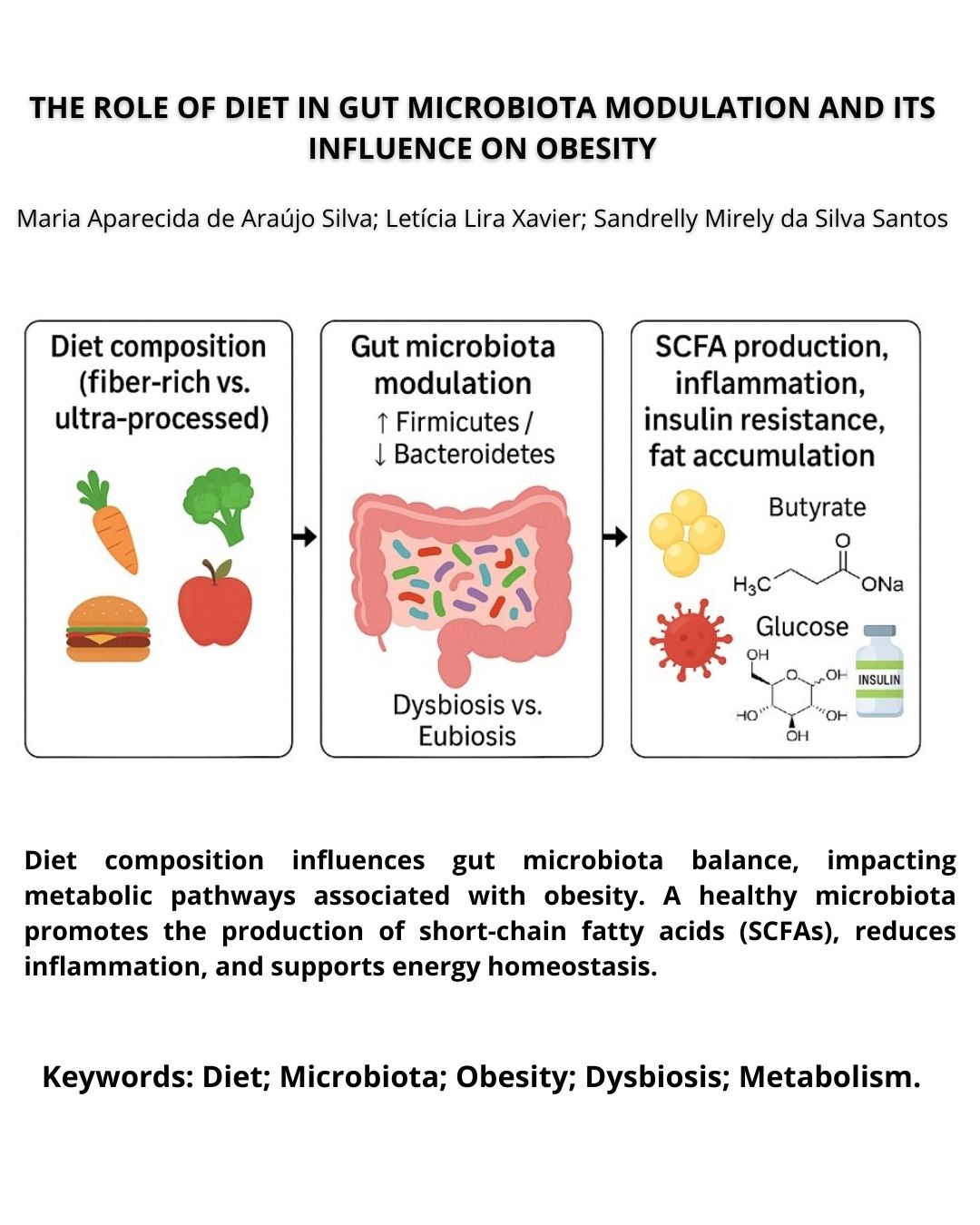
EL PAPEL DE LA ALIMENTACIÓN EN LA MODULACIÓN DE LA MICROBIOTA INTESTINAL Y SU INFLUENCIA EN LA OBESIDAD
DOI:
https://doi.org/10.64956/gm-unifacol.v2i1.18Palabras clave:
Alimentación, Microbiota, Obesidad, Disbiosis, MetabolismoResumen
Introducción: La obesidad es una condición multifactorial, asociada con disfunciones metabólicas e inflamatorias, cuyo desarrollo ha sido cada vez más relacionado con la composición de la microbiota intestinal.
Objetivo: Este trabajo tiene como objetivo revisar críticamente la evidencia científica sobre la influencia de la alimentación en la modulación de la microbiota intestinal y su relación con la obesidad.
Metodología: Se realizó una revisión integrativa de la literatura mediante una búsqueda estructurada en las bases de datos PubMed, SciELO, ScienceDirect y Scopus, centrándose en estudios publicados entre 2004 y 2024 que abordan los efectos de la dieta sobre la microbiota y los desenlaces metabólicos relacionados con la obesidad.
Discusión: Los estudios analizados señalan que los individuos con obesidad presentan disbiosis intestinal, caracterizada por la reducción de la diversidad microbiana y una alteración en la proporción entre los filos Firmicutes y Bacteroidetes. Este desequilibrio favorece una mayor extracción de energía de la dieta, el aumento de la producción de metabolitos proinflamatorios y la endotoxemia metabólica, contribuyendo a la resistencia a la insulina y a la acumulación de tejido adiposo. La producción de ácidos grasos de cadena corta (AGCC), como butirato, propionato y acetato, influenciada por la dieta y la composición microbiana, desempeña un papel relevante en la modulación del metabolismo lipídico, en la homeostasis energética y en la señalización hormonal del apetito. No obstante, estos efectos beneficiosos dependen de un estado de eubiosis.
Conclusión: Las intervenciones dietéticas que promuevan una microbiota intestinal equilibrada y funcional se configuran como estrategias prometedoras para la prevención y el manejo de la obesidad, al actuar directamente sobre los mecanismos fisiopatológicos implicados en su desarrollo.
Citas
ABDELHALIM, Khalid A. Short-Chain Fatty Acids (Scfas) from Gastrointestinal Disorders, Metabolism, Epigenetics, Central Nervous System to Cancer – A Mini-Review. Chemico-Biological Interactions, v. 388, p. 110851, 2024.
BÄCKHED, Fredrik et al. The Gut Microbiota as an Environmental Factor That Regulates Fat Storage. Proceedings of the National Academy of Sciences, v. 101, n. 44, p. 15718–15723, 2004.
CANI, Patrice D. et al. Changes in Gut Microbiota Control Metabolic Endotoxemia-Induced Inflammation in High-Fat Diet–Induced Obesity and Diabetes in Mice. Diabetes, v. 57, n. 6, p. 1470–1481, 2008.
CANI, Patrice D. et al. Metabolic Endotoxemia Initiates Obesity and Insulin Resistance. Diabetes, v. 56, n. 7, p. 1761–1772, 2007.
CANI, Patrice D. et al. Microbiota and Cardiometabolic Risk: What is the Next Step? Nature Reviews Cardiology, v. 12, n. 10, p. 540–549, 2015.
CHEN, Lijuan et al. The Long-Term Genetic Stability and Individual Specificity of the Human Gut Microbiome. Cell, v. 184, n. 9, p. 2302–2315, 2021.
COSTA, C. H. R. da et al. Transplante de Microbiota Fecal: Uma Abordagem Terapêutica Promissora? Revista de Ciências Médicas e Biológicas, v. 20, n. 2, p. 279–285, 2021.
CROVESY, Hannah M.; MASTERSON, Ana P.; ROSADO, Rosana R. Profile Of The Gut Microbiota of Adults With Obesity: A Systematic Review. European Journal of Clinical Nutrition, v. 74, p. 1251–1262, 2020.
DAO, Maria Carlota et al. Akkermansia Muciniphila and Improved Metabolic Health During a Dietary Intervention in Obesity: Relationship with Gut Microbiome Richness and Ecology. Gut Microbiota, v. 65, n. 3, p. 426–436, 2016.
DEN BESTEN, Gijs et al. The Role of Short-Chain Fatty Acids in The Interplay Between Diet, Gut Microbiota, and Host Energy Metabolism. Journal of Lipid Research, v. 54, n. 9, p. 2325–2340, 2013.
FAN, Yong; PEDERSEN, Oluf. Gut Microbiota in Human Metabolic Health and Disease. Nature Reviews Microbiology, v. 19, p. 55–71, 2021.
HJORTH, Mads F. et al. Prevotella-To-Bacteroides Ratio Predicts Body Weight and Fat Loss Success on 24-Week Diets Varying in Macronutrient Composition and Dietary Fiber: Results From a Post-Hoc Analysis. International Journal of Obesity, v. 43, n. 1, p. 149–157, 2019.
KASAI, Chika et al. Comparison of the Gut Microbiota Composition Between Obese and Non-Obese Individuals In a Japanese Population, as Analyzed by Terminal Restriction Fragment Length Polymorphism and Next-Generation Sequencing. BMC Gastroenterology, v. 15, n. 1, p. 100, 2015.
KHAN, M. T. et al. Gut Microbiota: Composition, Functions And its Role in Obesity and Related Metabolic Disorders. Microbial Pathogenesis, v. 111, p. 293–298, 2016.
LI, Cunyin et al. Gut Microbiota-Derived Short Chain Fatty Acids Act as Mediators of the Gut-Liver-Brain Axis. Metabolic Brain Disease, v. 40, n. 2, p. 122, 2025.
LIU, Ruixin et al. Gut Microbiome and Serum Metabolome Alterations In Obesity and After Weight-Loss Intervention. Nature Medicine, v. 23, n. 7, p. 859–868, 2017.
MARCHESI, Julian R. et al. The Gut Microbiota and Host Health: A New Clinical Frontier. Gut, v. 65, n. 2, p. 330–339, 2016.
OJO, Olufemi; WANG, Xueqing; OJO, Olabisi O. The Role of Dietary Polyphenols in Modulating Gut Microbiota and Inflammation. Nutrients, v. 13, n. 12, p. 1–18, 2021
PAGE, Matthew J. et al. The Prisma 2020 Statement: an Updated Guideline for Reporting Systematic Reviews. British Medical Journal, v. 372, n. 71, 2021.
RIDAURA, Vanessa K. et al. Gut Microbiota From Twins Discordant for Obesity Modulate Metabolism in Mice. Science, v. 341, n. 6150, p. 1241214, 2013.
RINNINELLA, Emanuele et al. What is the Healthy Gut Microbiota Composition? A Changing Ecosystem Across Age, Environment, Diet, and Diseases. Microorganisms, v. 7, n. 1, p. 14, 2019
SÁNCHEZ, María; DARIMONT, Christine; DORE, Jacques; et al. Effects of Lactobacillus rhamnosus GG and Bifidobacterium Animalis Subsp. Lactis on Weight Loss and Metabolic Parameters in Overweight and Obese Individuals. Nutrients, v. 12, n. 6, p. 1–16, 2020.
SEKIROV, Inna et al. Gut Microbiota in Health and Disease. Physiological Reviews, v. 90, n. 3, p. 859–904, 2010.
TURNBAUGH, Peter J. et al. An Obesity-Associated Gut Microbiome with Increased Capacity for Energy Harvest. Nature, v. 444, n. 7122, p. 1027–1031, 2006.
VALDES, Ana M. et al. Role of the Gut Microbiota in Nutrition and Health. British Medical Journal, v. 361, k2179, 2018.
VRIEZE, Anne et al. Transfer of Intestinal Microbiota from Lean Donors Increases Insulin Sensitivity in Individuals with Metabolic Syndrome. Gastroenterology, v. 143, n. 4, p. 913–916, 2012.
WORLD HEALTH ORGANIZATION Obesity and Overweight. Geneva, 2022. Disponível em: https://www.who.int/news-room/fact-sheets/detail/obesity-and-overweight. Acesso em: 2 abr. 2025.
ZHAO, Liping et al. Gut Bacteria Selectively Promoted by Dietary Fibers Alleviate Type 2 Diabetes. Science, v. 359, n. 6380, p. 1151–1156, 2018.