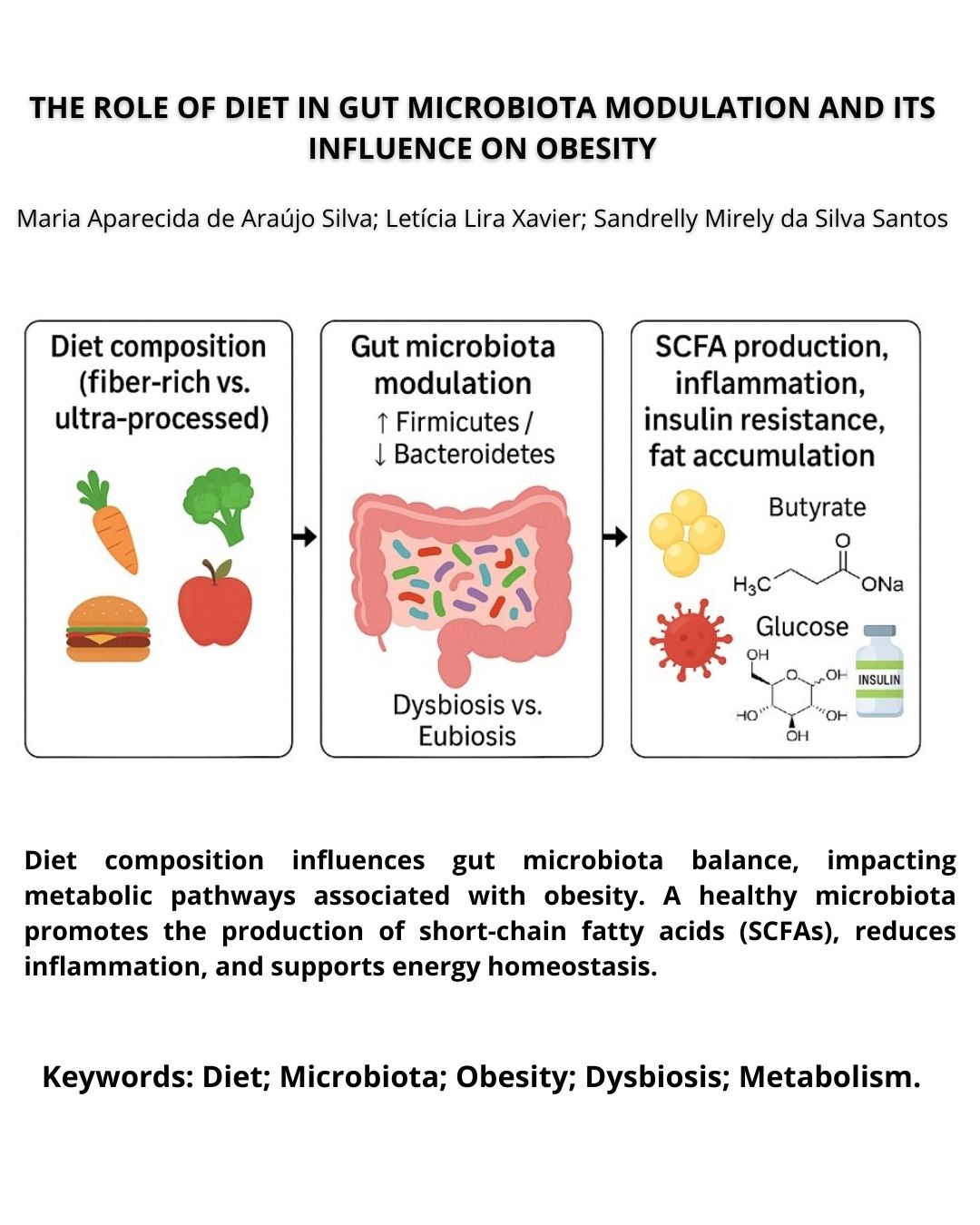
THE ROLE OF DIET IN GUT MICROBIOTA MODULATION AND ITS INFLUENCE ON OBESITY
DOI:
https://doi.org/10.64956/gm-unifacol.v2i1.18Keywords:
Diet, Microbiota, Obesity, Dysbiosis, MetabolismAbstract
Obesity is a multifactorial condition associated with metabolic and inflammatory dysfunctions, whose development has been increasingly linked to the composition and functionality of the gut microbiota. Recent literature shows that diet is a key modulator of this ecosystem, influencing metabolic, inflammatory, and hormonal pathways related to body fat accumulation. To critically review scientific evidence on the influence of diet on gut microbiota modulation and its relationship with obesity, highlighting pathophysiological mechanisms, therapeutic strategies, and intervention perspectives. An integrative literature review was conducted through a structured search in the PubMed, SciELO, ScienceDirect, and Scopus databases, considering studies published between 2004 and 2025. Original articles and reviews addressing the interaction between diet, gut microbiota, and obesity were included. After screening titles and abstracts, full texts were analyzed, excluding duplicates, studies focused solely on pharmacotherapy, and works without a clearly described methodology. The analyzed studies indicate that individuals with obesity often present gut dysbiosis, characterized by reduced microbial diversity and altered proportion between the phyla Firmicutes and Bacteroidetes. This imbalance promotes greater energy extraction from food, increased production of pro-inflammatory metabolites, and metabolic endotoxemia, contributing to insulin resistance and adipose tissue accumulation. Dietary strategies rich in fiber, prebiotics, probiotics, and bioactive compounds show potential to restore eubiosis, modulate inflammation, and improve metabolic parameters. However, methodological heterogeneity and population differences limit the generalization of findings, reinforcing the need for multicenter, long-term studies with methodological standardization. Nutritional modulation of the gut microbiota represents a promising and complementary approach in the management of obesity. Personalized interventions based on the individual microbial profile emerge as a strategic path to optimize clinical outcomes and prevent associated complications. Future research should prioritize the identification of robust microbial markers, the evaluation of long-term clinical outcomes, and the development of specific nutritional protocols that consider the ethnic, cultural, and genetic diversity of populations.
References
ABDELHALIM, Khalid A. Short-Chain Fatty Acids (Scfas) from Gastrointestinal Disorders, Metabolism, Epigenetics, Central Nervous System to Cancer – A Mini-Review. Chemico-Biological Interactions, v. 388, p. 110851, 2024.
BÄCKHED, Fredrik et al. The Gut Microbiota as an Environmental Factor That Regulates Fat Storage. Proceedings of the National Academy of Sciences, v. 101, n. 44, p. 15718–15723, 2004.
CANI, Patrice D. et al. Changes in Gut Microbiota Control Metabolic Endotoxemia-Induced Inflammation in High-Fat Diet–Induced Obesity and Diabetes in Mice. Diabetes, v. 57, n. 6, p. 1470–1481, 2008.
CANI, Patrice D. et al. Metabolic Endotoxemia Initiates Obesity and Insulin Resistance. Diabetes, v. 56, n. 7, p. 1761–1772, 2007.
CANI, Patrice D. et al. Microbiota and Cardiometabolic Risk: What is the Next Step? Nature Reviews Cardiology, v. 12, n. 10, p. 540–549, 2015.
CHEN, Lijuan et al. The Long-Term Genetic Stability and Individual Specificity of the Human Gut Microbiome. Cell, v. 184, n. 9, p. 2302–2315, 2021.
COSTA, C. H. R. da et al. Transplante de Microbiota Fecal: Uma Abordagem Terapêutica Promissora? Revista de Ciências Médicas e Biológicas, v. 20, n. 2, p. 279–285, 2021.
CROVESY, Hannah M.; MASTERSON, Ana P.; ROSADO, Rosana R. Profile Of The Gut Microbiota of Adults With Obesity: A Systematic Review. European Journal of Clinical Nutrition, v. 74, p. 1251–1262, 2020.
DAO, Maria Carlota et al. Akkermansia Muciniphila and Improved Metabolic Health During a Dietary Intervention in Obesity: Relationship with Gut Microbiome Richness and Ecology. Gut Microbiota, v. 65, n. 3, p. 426–436, 2016.
DEN BESTEN, Gijs et al. The Role of Short-Chain Fatty Acids in The Interplay Between Diet, Gut Microbiota, and Host Energy Metabolism. Journal of Lipid Research, v. 54, n. 9, p. 2325–2340, 2013.
FAN, Yong; PEDERSEN, Oluf. Gut Microbiota in Human Metabolic Health and Disease. Nature Reviews Microbiology, v. 19, p. 55–71, 2021.
HJORTH, Mads F. et al. Prevotella-To-Bacteroides Ratio Predicts Body Weight and Fat Loss Success on 24-Week Diets Varying in Macronutrient Composition and Dietary Fiber: Results From a Post-Hoc Analysis. International Journal of Obesity, v. 43, n. 1, p. 149–157, 2019.
KASAI, Chika et al. Comparison of the Gut Microbiota Composition Between Obese and Non-Obese Individuals In a Japanese Population, as Analyzed by Terminal Restriction Fragment Length Polymorphism and Next-Generation Sequencing. BMC Gastroenterology, v. 15, n. 1, p. 100, 2015.
KHAN, M. T. et al. Gut Microbiota: Composition, Functions And its Role in Obesity and Related Metabolic Disorders. Microbial Pathogenesis, v. 111, p. 293–298, 2016.
LI, Cunyin et al. Gut Microbiota-Derived Short Chain Fatty Acids Act as Mediators of the Gut-Liver-Brain Axis. Metabolic Brain Disease, v. 40, n. 2, p. 122, 2025.
LIU, Ruixin et al. Gut Microbiome and Serum Metabolome Alterations In Obesity and After Weight-Loss Intervention. Nature Medicine, v. 23, n. 7, p. 859–868, 2017.
MARCHESI, Julian R. et al. The Gut Microbiota and Host Health: A New Clinical Frontier. Gut, v. 65, n. 2, p. 330–339, 2016.
OJO, Olufemi; WANG, Xueqing; OJO, Olabisi O. The Role of Dietary Polyphenols in Modulating Gut Microbiota and Inflammation. Nutrients, v. 13, n. 12, p. 1–18, 2021
PAGE, Matthew J. et al. The Prisma 2020 Statement: an Updated Guideline for Reporting Systematic Reviews. British Medical Journal, v. 372, n. 71, 2021.
RIDAURA, Vanessa K. et al. Gut Microbiota From Twins Discordant for Obesity Modulate Metabolism in Mice. Science, v. 341, n. 6150, p. 1241214, 2013.
RINNINELLA, Emanuele et al. What is the Healthy Gut Microbiota Composition? A Changing Ecosystem Across Age, Environment, Diet, and Diseases. Microorganisms, v. 7, n. 1, p. 14, 2019
SÁNCHEZ, María; DARIMONT, Christine; DORE, Jacques; et al. Effects of Lactobacillus rhamnosus GG and Bifidobacterium Animalis Subsp. Lactis on Weight Loss and Metabolic Parameters in Overweight and Obese Individuals. Nutrients, v. 12, n. 6, p. 1–16, 2020.
SEKIROV, Inna et al. Gut Microbiota in Health and Disease. Physiological Reviews, v. 90, n. 3, p. 859–904, 2010.
TURNBAUGH, Peter J. et al. An Obesity-Associated Gut Microbiome with Increased Capacity for Energy Harvest. Nature, v. 444, n. 7122, p. 1027–1031, 2006.
VALDES, Ana M. et al. Role of the Gut Microbiota in Nutrition and Health. British Medical Journal, v. 361, k2179, 2018.
VRIEZE, Anne et al. Transfer of Intestinal Microbiota from Lean Donors Increases Insulin Sensitivity in Individuals with Metabolic Syndrome. Gastroenterology, v. 143, n. 4, p. 913–916, 2012.
WORLD HEALTH ORGANIZATION Obesity and Overweight. Geneva, 2022. Disponível em: https://www.who.int/news-room/fact-sheets/detail/obesity-and-overweight. Acesso em: 2 abr. 2025.
ZHAO, Liping et al. Gut Bacteria Selectively Promoted by Dietary Fibers Alleviate Type 2 Diabetes. Science, v. 359, n. 6380, p. 1151–1156, 2018.