AÇÕES ANTRÓPICAS E O CICLO SILVESTRE DA RAIVA
IMPACTOS DA INTERAÇÃO INDEVIDA ENTRE HUMANOS E ANIMAIS SILVESTRES
DOI:
https://doi.org/10.64956/gm-unifacol.v1i3.27Keywords:
Zoonoses, Quirópteros, Vigilância Epidemiológica, Saúde Pública, Tráfico de FaunaAbstract
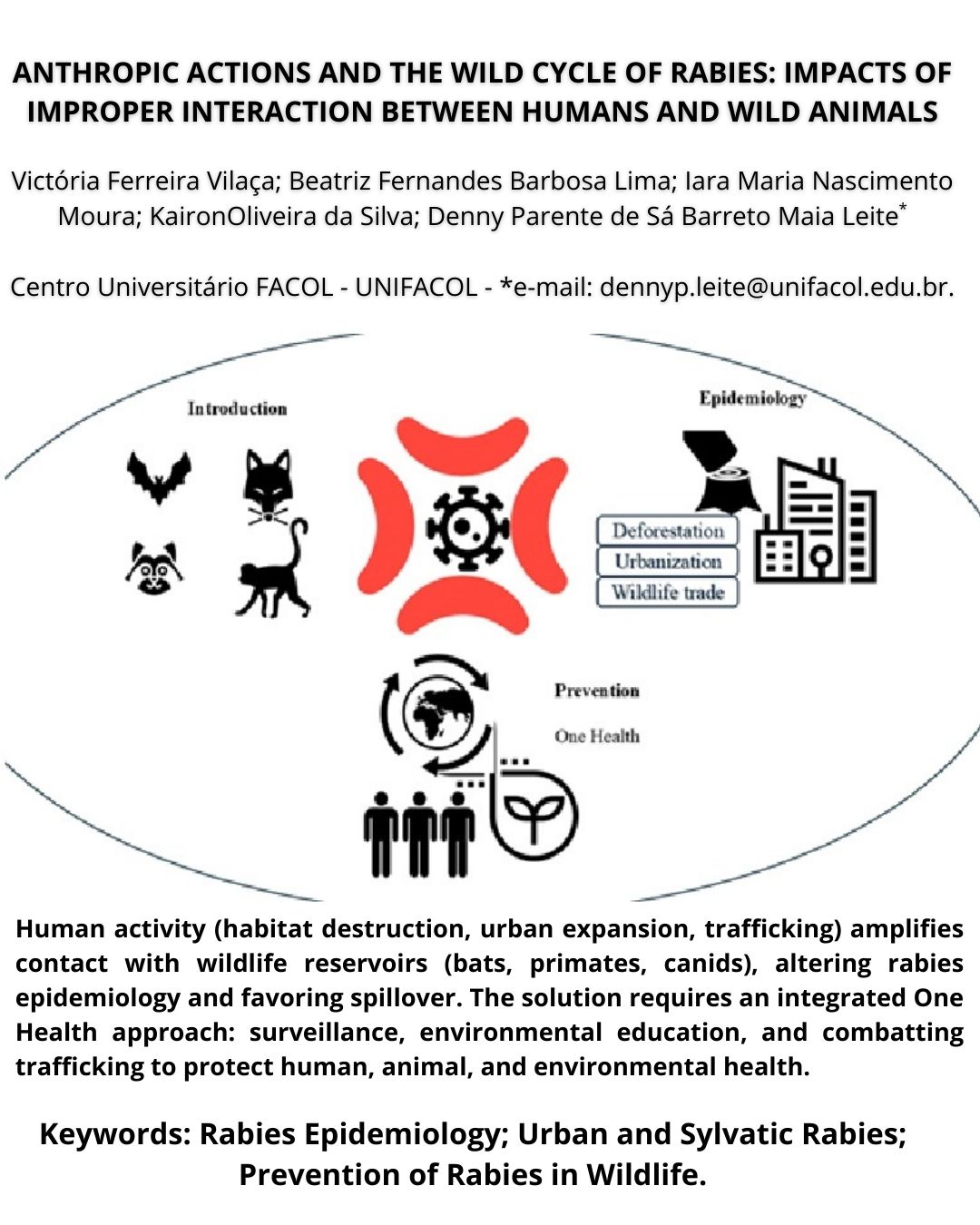
Rabies is a highly lethal viral zoonosis, whose transmission in the wild has intensified in recent decades due to increased anthropogenic activity. Habitat destruction, uncontrolled urban development, and wildlife trafficking are factors that favor contact between humans and wild species, such as bats, marmosets, and canines, the main reservoirs of the virus in the natural environment. This study aimed to review scientific literature on the impacts of human intervention on the wild rabies cycle, discussing changes in the disease's epidemiology and proposing prevention strategies based on the One Health approach. A qualitative narrative review was conducted, selecting articles published between 2000 and 2025 from the PubMed, SciELO, and Scopus databases. The data were analyzed along four axes: viral structure and mechanism of infection; main reservoirs and variants; epidemiology in Brazil and worldwide; and the impacts of human actions. The findings reveal that most recent human rabies cases in Brazil are associated with bats and primates, especially in socioeconomically vulnerable regions. Furthermore, there is growing evidence that environmental fragmentation and animal trafficking favor the emergence of new viral variants and their spillover to domestic and human hosts. The conclusion is that wild rabies must be addressed through integrated surveillance, environmental education, and the suppression of wildlife trafficking, considering the interdependence between human, animal, and environmental health.
References
BATISTA, Hélio B. C. R.; FRANCO, Ana C.; ROEHE, Paulo M. RAIVA: UMA BREVE REVISÃO. Acta Scientiae Veterinariae, Porto Alegre, p. 125-144, 2007.
BATISTA, Caroline R.; ESPARTOSA, Karina D.; OSHIKA, Monica T. Suzuki NÃO ALIMENTEM OS ANIMAIS SILVESTRES DO PARQUE: TEATRO COMO FERRAMENTA DE CONSCIENTIZAÇÃO. Revista Extensão e Cidadania, Vitória da Conquista, v. 8, n. 13, p. 258-273, 2020.
BARBOSA, Carolina B. F.; SANCHES, Lilian A.; FREIRE, Marina R. ZOONOSES TRANSMITIDAS POR ANIMAIS SILVESTRES ORIUNDOS DO TRÁFICO. São Paulo, 2014. Disponível em: https://bichosonline.vet.br/wp-content/uploads/2016/07/Zoonoses-transmitidas-por-animais-silvestres-provenientes-de-tr%C3%A1fico.pdf. Acesso em: 20 fev. 2025.
BASTOS, Victor; et al. NEUROIMMUNOLOGY OF RABIES: NEW INSIGHTS INTO AN ANCIENT DISEASE. Journal of Medical Virology, v. 95, n. 10, e29042, 2023.
BRASIL. Ministério da Saúde. Secretaria de Saúde do Estado de Pernambuco. Pernambuco identifica caso de raiva humana após 8 anos sem registro da doença. 2025. Disponível em: https://portal.saude.pe.gov.br/pernambuco-identifica-caso-de-raiva-humana-apos-8-anos-sem-registro-da-doenca/. Acesso em: 11 fev. 2025.
CARABALLO, Diego A. et al. A NOVEL TERRESTRIAL RABIES VIRUS LINEAGE OCCURRING IN SOUTH AMERICA: ORIGIN, DIVERSIFICATION, AND EVIDENCE OF CONTACT BETWEEN WILD AND DOMESTIC CYCLES. Viruses, v. 13, n. 12, p. 2484, 2021.
CORRÊA, Walter M.; CORRÊA, Célia N. M. ENFERMIDADES INFECCIOSAS DOS MAMÍFEROS DOMÉSTICOS. 2. ed. Rio de Janeiro: Medsi, 1992. 843 p.
FAVORETTO, Sônia R. et al. THE EMERGENCE OF WILDLIFE SPECIES AS A SOURCE OF HUMAN RABIES INFECTION IN BRAZIL. Epidemiology and Infection, v. 141, n. 7, p. 1552-1561, 2013.
FREELAND BRASIL. O TRÁFICO DE FAUNA SILVESTRE SEGUNDO AS NOTÍCIAS: AVALIAÇÃO DAS INFORMAÇÕES PUBLICADAS PARA O BRASIL, ARGENTINA E PARAGUAI. São Paulo: Freeland, 2023. Disponível em: https://www.freeland.org.br/post/freeland-publica-o-primeiro-relatorio-do-observatorio-do-trafico?utm_source=chatgpt.com. Acesso em: 11 fev. 2025.
HONG, Aangela; KYLAS, Anya RABIES. The Meducator, v. 1, n. 44, p. 4-5, 2023.
MEDEIROS, Flávia M. H. et al. IMPACTS OF RABIES ON WILDLIFE THROUGH A ONE HEALTH APPROACH. In: MEDEIROS, F. M. H.; et al. (Orgs.). Open Science Research XV. 1. ed. [S. l.]: Editora Científica Digital, 2024. p. 13-27.
MENEZES, Ramon E. R. EPIDEMIOLOGIA DA RAIVA SILVESTRE NO ESTADO DO RIO GRANDE DO NORTE. Mossoró: Universidade Federal Rural do Semi-Árido (UFERSA), 2018. Monografia (Graduação em Medicina Veterinária). Disponível em: https://repositorio.ufersa.edu.br/server/api/core/bitstreams/24a29863-586c-4719-8f7c-2002bb0ef74b/content. Acesso em: 13 fev. 2025.
MORANDI, Nathália M. G.; GOMES, D. E. RAIVA ANIMAL – UMA REVISÃO. Revista Científica Unilago, São José do Rio Preto, v. 1, n. 1, 2022.
ROCHA, Sílvia. M. et al. EPIDEMIOLOGICAL PROFILE OF WILD RABIES IN BRAZIL (2002–2012). Transboundary and Emerging Diseases, v. 64, n. 2, p. 624-633, 2017.
SILVA, Camila J. A. et al. PANORAMA EPIDEMIOLÓGICO DA RAIVA HUMANA NA REGIÃO NORDESTE DO BRASIL DE 2013 A 2017. Anais da Faculdade de Medicina de Olinda, Recife, v. 6, n. 2, p. 7, 2020. Disponível em: https://afmo.emnuvens.com.br/afmo/article/download/146/93/591. Acesso em: 19 fev. 2025.
SILVA, Lóren Andrade; OLIVEIRA, Túlio E. S.; JÚNIOR, M. C. RAIVA EM ANIMAIS SILVESTRES. Anais do Simpósio Acadêmico da UNIVIÇOSA – SIMPAC, Viçosa, v. 4, n. 1, 2015. Disponível em: https://revista.univicosa.com.br/index.php/RevistaSimpac/article/view/232. Acesso em: 12 jul. 2025.
TAZERJI, Sina S. et al. AN OVERVIEW OF ANTHROPOGENIC ACTIONS AS DRIVERS FOR EMERGING AND RE-EMERGING ZOONOTIC DISEASES. Pathogens, v. 11, n. 11, p. 1376, 2022.